

Contents
Family Delphacidae Leach, 1815
Subfamily Delphacinae Leach, 1815
Tribe Delphacini Leach, 1815
Genus Neomegamelanus McDermott, 1952
Type species (in original combination): Megamelanus lautus Metcalf, 1923.
Distribution
East and Gulf Coast of the US and Mexico; Bermuda, Caribbean.

Distribution of Neomegamelanus (from FLOW 26 June 2017)
Recognized species
Five valid species plus one subspecies as follows:
Neomegamelanus dorsalis (Metcalf, 1923) – see N. spartini
Neomegamelanus elongatus (Ball, 1905) – USA: CT, DE, FL, GA, LA, MA, MD, MS, NC, NJ, NY, SC, TX, VA; Anguilla, Bahamas (Abaco Cay, Andros, Barry, Eleuthera, Exuma Cays, San Salvador)
= Megamelanus elongatus Ball, 1905: 118.
= Neomegamelanus elongatus (Ball, 1905); comb. by McDermott 1952: 50-51.
Neomegamelanus elongatus reductus (Caldwell, 1951) – Puerto Rico, Vieques Is
Neomegamelanus graminicola (Muir, 1928) – Bermuda
Neomegamelanus lautus (Metcalf, 1923) – USA: LA, MS, TX; Mexico (Veracruz)
= Megamelanus lautus Metcalf, 1923: 200.
= Neomegamelanus lautus (Metcalf, 1923); comb. by McDermott 1952: 52-54.
Neomegamelanus penilautus McDermott, 1952 – USA: Florida
Neomegamelanus spartini (Osborn, 1905) – USA: DE, FL, LA, MD, ME, MS, NC, NJ, NY, VA, VT (reported in error: USA: OH; VT may be mislabeled specimens)
= Megamelanus spartini Osborn, 1905: 375.
= Megamelanus dorsalis Metcalf, 1923: 199.
= Neomegamelanus spartini (Osborn, 1905); comb. by McDermott 1952: 41.
= Neomegamelanus dorsalis (Metcalf, 1923); comb. by McDermott 1952: 48-49.
= Neomegamelanus dorsalis (Metcalf, 1923); Syn. by Kennedy et al. 2012: 404-405.
Hosts
All are in coastal marshes, expected to be Spartina feeders.
Neomegamelanus spartini (as dorsalis) – Spartina patens (Aiton) Muhl. (saltmeadow cordgrass)
Neomegamelanus elongatus – Spartina patens (Aiton) Muhl.
Neomegamelanus elongatus reductus– Sporobolus virginicus (L.) Kunth (seashore dropseed)
Hosts from Wilson et al, 1994 et cit. ,Wilson 2012; See also FLOW.
Economic Importance: Limited.
Recognition
Unusual fragile appearing, long-headed species. The head bears a unique carina between the top of the compound eye, across the temple, to the lateral carina of the frons, which is absent in the similar Tumidagena. All species in coastal marshes where they are often abundant. Ecological aspects of Neomegamelanus species frequently noted in work by Denno and colleagues, although most of this literature relates more directly to Prokelisia species.
Key to the Species of Neomegamelanus (modified from McDermott 1952)
1- Genital styles widening at apices; elytra without whitish triangles near apices … 2
1′- Genital styles acuminate at apices; elytra with opposing triangles at apices, one on the inner margin, the other on the front margin … 3
2- In caudal view anal segment with two pairs of processes, a short straight, spine-like upper pair, and below these a much longer slender curved pair. Hind legs black and white… Neomegamelanus spartini (as dorsalis)
2′- In caudal view anal segment with but a single pair of short spine like processes, hind legs uniformly straw colored … Neomegamelanus elongatus
3- Head about twice as long as wide at base; upper hind corner of anal segment produced into a lobe; a single pair of curved fang-like processes arising from about the middle of the hind margin … Neomegamelanus lautus
3′- Head long, about three times as long as wide at base, upper hind corner of anal segment not produced into a lobe; processes arising from hind margin straight, tusk-like. Neomegamelanus penilautus

Neomegamlenus elongatus (male)Neomegamelanus spartini (male, female is not as dark; note dark legs)

(below: Male left, female right)

 Neomegamelanus spartini (female, note dark legs)


Neomegamelanus penilautus (pale individual is female)
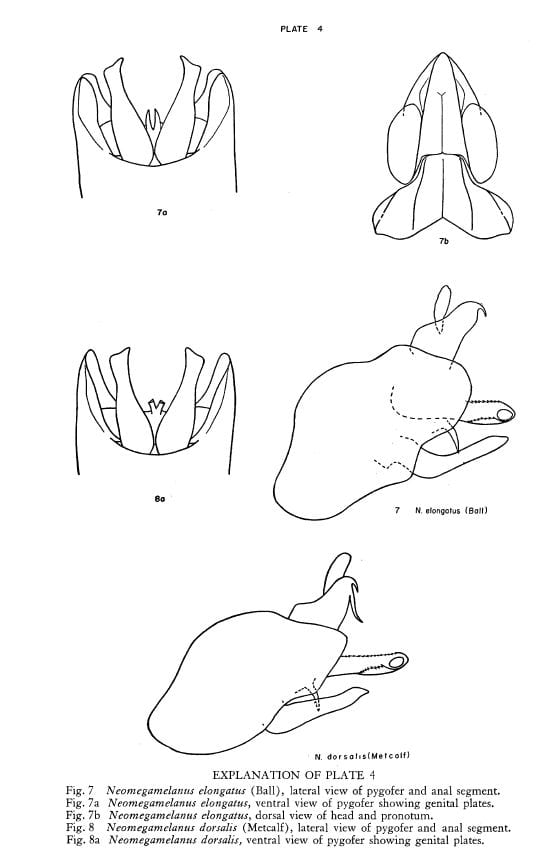
Neomegamelanus from McDermott 1952

Neomegamelanus lautus and N. penilautuus from Mcdermott 1952

Neomegamelanus aedeagi from Mcdermott 1952
Online resources
3i.
EOL.
Bugguide.
Discover Life.
FLOW.
Hoppers of North Carolina.
American Insects.
BOLD.
GBIF.
iNaturalist.
Molecular resources
At this time BOLD provides molecular data for this N. elongatus and GenBank has 18S rDNA, 28S rDNA, wingless, and cytochrome oxidase I from Neomegamelanus elongatus.
References
Ball, E. D. 1905a. Some new Homoptera from the south and southwest. Proceedings of the Biological Society of Washington 18: 117-120.
Bartlett, C. R., L. B. O’Brien and S. W. Wilson. 2014. A review of the planthoppers (Hemiptera: Fulgoroidea) of the United States. Memoirs of the American Entomological Society 50: 1-287.
Caldwell, J. S. and L. F. Martorell. 1951 [dated1950]. Review of the Auchenorynchous Homoptera of Puerto Rico. Part II. The Fulgoroidea except Kinnaridae. Journal of Agriculture of the University of Puerto Rico 34(2): 133-269. (i.e., Caldwell 1951)
Cummins, J. D., S. W. Wilson, P. D. Calvert and J. H. Tsai. 1988. Neomegamelanus elongatus (Homoptera: Delphacidae): descriptions of immatures. Journal of the New York Entomological Society 96(3): 260-265.
Davis, L. V. and I. E. Gray. 1966. Zonal and seasonal distribution of insects in North Carolina salt marshes. Ecological Monographs 36(3): 275-295.
Denno, R. F. 1977. Comparison of the assemblages of sap-feeding insects (Homoptera-Hemiptera) inhabiting two structurally different salt marsh grasses in the genus Spartina. Environmental Entomology 6: 359-372. [Ecological notes]
Denno, R. F. 1980. Ecotope differentiation in a guild of sap-feeding insects on the salt marsh grass, Spartina patens. Ecology 61(3):702-714.
Denno, R. F., G. K. Roderick and K. L. Olmstead. 1991. Density-related migration in planthoppers (Homoptera: Delphacidae): the role of habitat persistence. American Naturalist 138(6): 1513-1541.
Kennedy, A. C., C. R. Bartlett and S. W. Wilson. 2012. An annotated checklist of the delphacid planthoppers (Hemiptera: Delphacidae) of Florida with the description of three new species and the new genus, Meristopsis. Florida Entomologist 95(2): 395-421.
Leach, W. E. 1815a. Entomology. The Edinburg encyclopedia; conducted by David Brewster 9: 57-172. (family Delphacidae on p. 125)
McCoy, E. D. and J. R. Rey. 1981. Patterns of abundance, distribution, and alary polymorphism among the salt marsh Delphacidae (Homoptera: Fulgoroidea) of northwest Florida. Ecological Entomology 6(3): 285-291.
McDermott, B. T. 1952. A revision of the genus Megamelanus and its allies (Homoptera, Fulgoroidea, Delphacidae). Journal of the Kansas Entomological Society 25: 41-49.
Meagher, R. L., Jr., S. W. Wilson, H. D. Blocker, R.V.W. Eckel and R. S. Pfannenstiel. 1993. Homoptera associated with sugarcane fields in Texas. Florida Entomologist 76(3): 508-514
Metcalf, Z. P. 1923a. A key to the Fulgoridae of Eastern North America with descriptions of new species. Journal of the Elisha Mitchell Scientific Society 38(3): 139-230, plus 32 plates. [from http://www.lib.unc.edu/dc/jncas/]
Metcalf, Z. P. 1943. General Catalogue of the Hemiptera. Fascicle IV, Fulgoroidea, Part 3, Araeopidae (Delphacidae). Smith College, Northhampton, Massachusetts.
Metcalf, Z. P. 1949. The redescription of twenty-one species of Areopidae described in 1923. Journal of the Elisha Mitchell Scientific Society 65(1): 48-60 plus, 4 plates.
Osborn, H. 1905. Descriptions of new North American Fulgoridae. Ohio Naturalist 5: 373-376.
Raupp, M. J. and R. F. Denno. 1979. The influence of patch size on a guild of sap-feeding insects that inhabit the salt marsh grass Spartina patens. Environmental Entomology 8(3): 412-417.
Tallamy, D. W. and R. F. Denno. 1979. Responses of sap-feeding insects (Homoptera: Hemiptera) to simplification of host plant structure. Environmental Entomology 8:1021-1028. https://doi.org/10.1093/ee/8.6.1021
Wilson, M. R. and D. J. Hilburn. 1991. Annotated list of the Auchenorrhynchous Homoptera (Insecta) of Bermuda. Annals of the Entomological Society of America 84(4): 412-419.
Wilson, S. W. 2012. Tymbal morphology and co-occurrence of Spartina sap-feeding insects (Hemiptera: Auchenorrhyncha). Great Lakes Entomologist 45(3-4): 166-184.
Wilson, S. W. and J. E. McPherson. 1980. The distribution of the Fulgoroidea of the Eastern United States (Homoptera). Transactions of the Illinois State Academy of Science 73(4): 7-20.
Wilson, S. W., C. Mitter, R. F. Denno and M. R. Wilson. 1994. Evolutionary patterns of host plant use by delphacid planthoppers and their relatives. Pp. 7-45 & Appendix. In: R. F. Denno and T. J. Perfect, (eds.). Planthoppers: Their Ecology and Management. Chapman and Hall, New York.
