France: Experiences in Learning In & Out of the Classroom

Submitted by Riley Thomas on the 2016 fall semester study abroad program in Paris, France…

As of writing this, I have now spent over a full month in Paris. More than a full month away from my family and friends, in a whole new country, speaking an entirely different language, it feels simultaneously like both a lifetime I have been here and a few passing days. While the past month has been full of surprises, no surprise is bigger than how much I am constantly learning.

I am attending school at the Insitut Catholique de Paris (ICP) as part of their Intsitut de Langue et de Culture Francaises; in other words, I’m a part of international classes with other students trying to improve their French just like me. Not only am I taking my required French language courses, but we have civilization courses as well, all taught in French. After having taken three weeks of classes at the ICP, I have noticed some pretty big differences between university life here in France compared to back at UD. First, the ICP is for the most part a commuter school. While there are some dorms offered, a vast majority of students, myself included, live off-campus. Residence hall life and student organizations aren’t really a part of the college experience. That isn’t to say, however, that there aren’t any social opportunities for students. The courtyard and cafeteria are always packed with students – both French and international – hanging out, working and eating. Additionally, there are outside events that students can take part in such as cooking workshops.

Another large difference is the length of classes. While I’ve had three hour studio classes at UD, each of my classes at ICP is three hours long and meets once a week. This means you have lots of information to absorb each class period, but a week in between each class to do your homework and study. A really cool part of being part of the international program is having classes where students come from all over the world and our shared language is the language we are learning together. Also, getting to hear our professors explain the definitions of French words we may not know in French rather than using the English translation gives me a better grasp on the exact connotation for these words, especially if there isn’t an exact translation to English.

Other opportunities for learning don’t just come in the classroom, however. I find some of my most poignant experiences come from everyday life. From dinners with my host family to going out with my friends and a group of language exchange partners, I am always learning new and interesting phrases as well as tidbits about French culture and current events. In return, I am able to offer the same regarding English and American culture. This exchange is what I find most valuable and has led to many nights around the dinner table researching seemingly mundane things such as blueberries or acorns in order to figure out if we had all been on the same page. Learning the current slang and working up the courage to incorporate new words into my everyday vocabulary is also a big part of my everyday life, and while frustrating at times – the amount of American slang and colloquialisms my host sister and her friends know is leagues beyond where I am – I am always grateful for the help.

All in all, I can’t believe how far I’ve come on a comfort and confidence level and I’m excited to see what these next two months hold.
desk-in-paris-riley-thomas-16f-paris-sm


How I Fell in Love with the Tower of London

Submitted by Kathryn Deaver on the 2016 fall semester study abroad program in London, England…

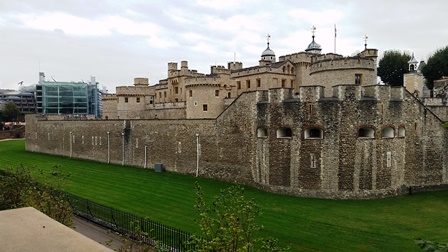
Hands down, my favorite site in London so far has been the Tower of London. As both an English history enthusiast and a lover of old stone buildings, I was enthralled by the Tower. Around 900 to 1,000 years old, it has a checkered history as both a castle and a prison, a sign of conquest and a sign of doom.

?

The original structure, William the Conqueror’s White Tower, was begun in the 1070’s in the southeast corner of the old Roman city that became London. Primarily built as a fortress, the Tower nonetheless entertained its fair share of royal guests during the ensuing centuries. Monarchs such as Henry III and Edward I embarked on extensive building projects to shore up the Tower’s defenses and increase its grandeur. (As Edward I is my great-times-a-lot grandfather, I plan on requisitioning my own set of royal apartments in this section of the Tower as soon as possible. Stay tuned for updates about this on-going process.)

The Tower of London is probably most famous for its role as a prison for important political prisoners. Confined to the Tower for anywhere from days to years, prisoners carved intricate designs and words all over the interiors of their cells, leaving messages that we’re still reading centuries later. Residents included bishops, nobles and even the King of France. However, humans were not the only creatures trapped there. Additionally, exotic animals such as lions, tigers and bears (go ahead, you can say it: Oh my!) were kept in the Tower. One exhibit I read even talked about a polar bear that was regularly let out on a long leash to fish in the Thames!

Another key animal in the Tower’s history is the raven, affectionately called the “guardians of the Tower.” Legend says that if the ravens ever leave the Tower, it and the kingdom will fall. Since the time of Charles II, at least six ravens have been kept at the Tower. Now, they have multiple back-up ravens and they clip all of their wings – which is cheating, in my opinion. Since you must be a member of the military to live in the Tower, all of the ravens are honorary soldiers and can be dismissed from service for unsatisfactory conduct which has happened. They do, after all, have a reputation to maintain.

Of course, no visit to the Tower is complete without a glimpse of the gorgeous Crown Jewels, some of the most recognizable symbols of the monarchy. The collection includes various coronation crowns and one-of-a-kind items used in all sorts of royal ceremonies. Passing through thick vault doors to see the showcases felt a little like Harry Potter’s descending into Gringotts Bank, except without the dragon (at least as far as I know).

Sadly, one six-hour visit to the Tower of London was not enough to do everything that was there. My roommate and I rented audio guides and wandered through all the buildings we could during its five tours, but we did not have the time or energy for a Yeoman Warder guided tour. This meant we were not able to go into the chapel of St. Peter ad Vincula, which houses the graves of Anne Boleyn and St. Thomas More, among others, so I’ll just have to go back!

Explore the history and beauty of the Tower of London here: http://www.hrp.org.uk/tower-of-london/

Play a fun game about the prisoners of the Tower: http://www.hrp.org.uk/games/prisoners/index.htm

Check out more about the Tower ravens here: https://youtu.be/4GkR4XBHkRo

Spain: Escorial, Madrid and Toledo

Submitted by Brianna Ramirez on the 2016 fall semester study abroad program in Granada, Spain…

This particular weekend was very busy and full of amazing experiences. After riding on a bus for five hours, we arrived in Escorial, a little town north of Madrid. This location is where all, except for four, of the Spanish kings and queens were buried. It was a quaint little town with a huge palace where we got to see amazing works of art and the burial site of the royal families.

Later that day, we headed over to Madrid and stopped by our hotel. After dropping off our luggage, we took a walk around the city. It was definitely a change from Granada; it was much bigger and full of tourists. The next day was filled with activities back to back. First, we went to The Congress of Deputies, which is where the Congress and the Senate meet to pass laws and handle government budgets. It was a short tour, but one of my favorites because it had the most relevance to present day politics in Spain.

congreso-de-los-diputados-madrid-brianna-ramirez-16f-granada-sm
Congreso de los diputados

Next, we headed over to Museo del Prado (Prado Museum) where we saw works by El Greco and Velazquez. My favorite painting which I had been learning about for years now, was Las Meninas. It was so amazing to be able to see it in person, to see the brush strokes and to analyze the different aspects of it. Later, we went to El Palacio Real (Royal Palace), which is currently not occupied by the royal family.

palacio-real-madrid-brianna-ramirez-16f-granada-sm
Palacio Real

That night, we went to the Reina Sofia (Queen Sofia Art Museum), which has all of Picasso’s work. They even had his sketches hung up on the wall and seeing Guernica was very impressive. I didn’t think it would take up a whole wall so I stood in front of it for a good 20 minutes. They also had very interesting contemporary art paintings and sculptures.

The following day, we left Madrid and visited Toledo. It reminded me a lot of Granada because it was a small town and had a fortress that overlooked the city similar to the Alhambra.  During our visit, we went to a synagogue and a cathedral. There were a lot of similarities in the architecture of the cathedral when compared to the cathedral in Granada. Overall, it was a memorable weekend that combined both art and culture. I really enjoyed being able to see the things I learned about in textbooks being applied to real life.

Czech Republic: Happy Birthday Havel !

Submitted by Margaret McNamara on the 2016 fall semester study abroad program in Prague, Czech Republic…

One of the most well-loved Czech figures—both in the Czech Republic and around the world—is Václav Havel, the first president of the Czech Republic. Before he was elected president, he was a writer, philosopher and some say he was one of the greatest intellectuals of the 20th century. During communist time his work caught the attention of the government and he was imprisoned. The communist party saw him as a controversial figure, but I suppose that’s what the Czech people needed at the end of that era so Havel became president of the Czech Republic. His birthday is October 5th and all month there have been memorials placed around Prague.

havel-memorial-prague-margaret-mcnamara-16f-prague-sm

Walking around the city, it’s evident that the Czech people have lots of respect for their former leader. There’s a genuine and perhaps unanimous admiration for this man and I don’t think I’ve experienced this kind of love for a political figure anywhere else in the world. It’s little differences like this that make me curious about a place’s literature and history. It makes me want to dig to fill in the gaps about what makes a culture love someone so much, what greatness is here and more. While I don’t have the answers to all of that just yet, I love these moments when you ask the right question and you know the explanation will offer a huge insight into the place you are in.

A New View of London

Submitted by Megan Garner on the 2016 fall semester study abroad program in London, England…

This past week, I had the opportunity to visit an incredible site here in London. One of the skyscrapers within the heart of London, accurately nicknamed the “Walkie Talkie” for its square yet curving appearance, has at the top of it, a public enclosed rooftop garden. I was lucky enough to be able to book it: while free, they have a very limited number of spaces each day. My roommates and I made our way up the 35 stories (via elevator, thankfully) and stepped out into a lush space.  A terrace of steps made its way up two more stories, covered in plants and trees. All of the walls were made of glass, and outside there was a balcony looking over the Thames and the city surrounding it.

The view was breathtaking and I was amazed at how many sites we could see: the London Eye, Big Ben, St. Paul’s Cathedral, the Rocket, the Shard, even the previous Olympic Stadium, all from this one vantage point. After taking in the view, we went back into the incredible garden, ordered tea and scones from the café and took a seat at a table. It was then, that I had a realization of how lucky I was.  After acclimating to life in London, it took a moment such as that to remind myself of how incredible the opportunity is that I am currently living. It’s so easy to begin to take advantage of the city as I grow accustomed to it, but seeing it all from a new perspective reminded me of how fortunate I truly am.

the-new-view-of-london-by-megan-garner-16f-london-england-sm

France: Monet’s Inspiration

Submitted by Olivia Toth on the 2016 fall semester study abroad program in Paris, France…

This past week, I had the opportunity to take a trip to Giverny, just outside Paris.  My friends and I woke up early to catch a train, all very excited to see the gardens of Monet.  I always remember studying his works in French class and seeing his beautiful paintings and I couldn’t believe we were about to see the place that inspired many of them in person.  When we arrived, the town reminded me of something out of a fairy-tale.  The gardens were stunning.  The first part was filled with flowers still in bloom even though it was October.  The section we were really looking forward to was the water gardens, where Monet took inspiration for his famous paintings of the lily pads.  It was like we were standing in the painting Bridge Over a Pond of Water Lilies when we finally reached this famous site.  It was an amazing experience to visit the place where Monet took so much inspiration especially since I’ve always learned about his works in school.giverny-olivia-toth-17s-france-sm

London: There’s No Place Like “Home”

Submitted by Megan Garner on the 2016 fall semester study abroad program in London, England…

As I begin to travel outside of London, its becoming quite clear that one of two things is true: 1) I absolutely made the right decision choosing London for myself to study abroad to, or 2) the longer I spend in London, the more it has become my home. Probably, it is actually a mix of these two, but these facts became much more apparent to me during my visit to Ireland this weekend.  Ireland was beautiful. It is definitely one of my favorite places I’ve visited; I would even consider making a return trip.  Inspite of everything I loved about Ireland, its flaws continued to yell out to me far louder than anything else. Most of the food was just British food “passed of as Irish” in my mind, the public transport made me aching to be back on the Tube and the city just couldn’t manage to leave me with the “feeling” I find myself with in London.

Despite all of that, Ireland was as beautiful and amazing as I hoped it would be. We spent one day exploring Dublin and the second day we traveled by train outside of the city to a small beach town called Greystones. It was incredible to see the kind of jagged cliffs that form on the Irish seashore unlike anywhere I know in the United States and the large pebbles and stones that line the shore instead of sand. It was great to leave the busy hectic life of a city behind for a day. The best feeling though, that I’ve found that I’ve gotten every time we traveled, is the feeling of peace that washes over me on the Tube ride home from the airport. It’s as though I just immediately know: I’m back home.

France: Opening Your Eyes

Submitted by Lindsay Kaslow on the 2016 fall semester study abroad program in Paris, France…

Last weekend, we had the opportunity to see Les Châteaux de la Loire with our program – lots of French History and beautiful architecture in all of these castles.  Unfortunately, I had some sort of weird pain in my lower back every time I sat down, which wasn’t conducive to the long bus ride to and from Paris.

chateau-de-chambord-loire-valley-excursion-lindsay-kaslow-16f-paris-sm

On Tuesday morning, on my way home from running errands, I couldn’t sit on the metro seats, and I could barely walk from the station to my apartment. So naturally, when my host mom got home, I asked her for help.

New French experience #1: in metropolitan areas, doctors will come to your house. That was helpful until I learned that the doctor didn’t speak English.  How was I supposed to describe what I was feeling, exactly where I could pinpoint the pain, the fact that I hadn’t done anything specific?  Luckily, there was a physically visable element: a very obviously painful and tender lump.  So with Word Reference in one hand, a prescription in the other and my host mom standing by, the doctor informed me that I had a cyst and that if it didn’t open and resolve in two days, I would need a surgeon to cut it open.

Honestly, that whole process that evening upset me more than I’d like to admit – not because I’m scared of having a cyst (because they’re actually quite common), but because when you’re in pain, it’s really frustrating to struggle with communication.  I’ve always had sympathy in the States for people with that problem – where I come from, I’ve seen many Hispanics struggle with it, and my heart went out to them.  But until you experience it firsthand, you’ll never understand. Little did I know that I would learn that lesson to a whole new extent a few days later.

On Wednesday night, I did not sleep; there was not a single position to lie in that didn’t cause excruciating pain. I got up in the morning to tell my host mom what was happening, and she sat with me as I decided to go to the hospital. This woman, who has known me for only a month, cancelled her yoga session and did not go to work so that she could sit in an ER waiting room for hours while I saw another doctor, explaining the situation on an as-allowed basis.

People often stereotype Parisians as cold, unwelcoming people.  If there were one thing that I could teach the world from studying here, it’s that that stereotype couldn’t lack any more truth.  Parisians have been some of the most helpful, warm and attentive people I have ever met so long as you don’t give them reason to be otherwise.

All this led to new French experience #2: the doctor couldn’t drain the cyst as it was too deep, so I was admitted to the hospital to await surgery until that night.  Explaining my dilemma to the first doctor and various nurses was hard enough – once again, no one spoke English.  But everyone whom I saw had lasting patience with me while I searched for the right words, and they helped me fill in gaps where I lacked ability.  As they put me in a wheelchair and rolled me up to my room, they made sure I understood what was happening and tried to make sure I was comfortable.

The wait was incredibly long and hard – 18 hours sans food, sans water, some sans company. Pain doesn’t stop, hospitals are noisy and uncertainty can often be your enemy.  My host parents came back for several hours in the evening, and one of my good friends came until the nurse kicked her out at 11:00 pm.  With new doctors and nurses coming in and out every hour, trying to communicate with me, I could piece together more and more.  While I couldn’t always formulate the right answers, I understood everything they told me, and I could help them understand my dilemma. And finally, at 2:00 am, when they rolled me into the operating room, I knew exactly what was going to happen and the staff knew exactly how I felt and what I needed.

Luckily, the next day, my program director was able to come and translate during the complicated exit process.  When I finally got home and had time to reflect, I couldn’t stop thinking about how much I had learned.  My French medical vocabulary had grown.  My communication and comprehension skills had really been tested.  And the biggest lesson I learned was that when you travel with people or share special memories with them, it brings you closer; you really learn a lot about them, and it changes your life.  When my host parents return from their weekend trip, I won’t see them in the same light.  I’m indebted to my friend, who sat on the edge of my bed for six hours just so I could have someone to talk to.  I’m thankful for the patience of people who know how to work with people who speak other languages, and I can’t wait to be able to help others more when they struggle in the same way I did.

It’s been one month, and I’m so thankful to be in France.  Hospital or not, pain or not, frustration or not.  Everyone says that study abroad will teach you a language and more importantly, a culture, but it teaches you even more than that.  It teaches you to bond with people, how to sympathize with anyone in a world full of differences and it teaches you to trust in yourself and your abilities.

France: Bread and Berets: What more could you ask for?

Submitted by Kaitlyn Diehl on the 2016 fall semester study abroad program in Paris, France…

Stereotypes are an intriguing facet of cultures because they all find their roots in some form of truth. As ludicrous as it seems to pinpoint Paris as the city of baguettes and frômage (cheese), I can’t help, but observe the inordinate amount of bread and cheese consumed in this city. To say that Parisians don’t carry a loaf of bread around at all times would be… well, a lie. Okay maybe that’s a bit of an exaggeration, but take this evening for example. I was waiting for the elevator in my apartment along with a fellow resident when she all of a sudden pulled out a baguette and started to chow down. The situation felt so cliche that I almost let out a snort. There’s bread for dinner, bread for breakfast, bread on every street corner. America runs on Dunkin™ and France runs on bread.

Perhaps the most prominent Parisian stereotype to graze the United States would be that of the “fashionable city.” Does it check out? For the most part it does, but not in the way that an outsider would imagine. My daily trek to school does not leave me stepping on Louis Vuitton heels in the metro or running into Gigi Hidad on her way to work. Instead, I am confronted with ordinary people who look their ordinary best. We can’t all have the face of an angel, but we can at least work with what we are given. The Parisians understand this concept and run with it. Sloppy sweatpants and that T-shirt you won at a 5K two years ago will never grace the public eye. Flip flops and short-shorts are a fashion faux pas among countless other tasteless American trends. After spending three weeks in this city, I’ve realized that the Parisian bar is not very high, it’s just that the American bar does not exist. Of course, we have standards in the work place and at school, but when I start to ponder some of the outfits I’ve seen at my local Acme or Walmart, I start to understand the reputation we have abroad. With the rare exception, most Parisians are dressed nice: Scarves, trendy jackets, clean shoes, a bit of make-up, etc. Always presentable.

Karlie Kloss
Karlie Kloss

If we’re going to delve into the segment of fashion that got France its reputation, let’s talk about Fashion Week. THIS is the time to step on Luis Vuitton heels and run into Gigi on the streets. Starting on September 27th and ending October 5th, fashion week is basically the reveal of this season’s latest trends by the biggest designers around town. All kinds of fashionistas and celebrities come out of the woodwork in order to attend and take part in the shows. I had the pleasure of experiencing some of this madness on the streets with my host sister, Marina. Unbeknownst to me, Rue St. Honore is the new 5th avenue of Paris and the current hub of Fashion Week recipients (some would argue Champs-Élysées, but according to Marina that street has become cheap). Simply walking down the street, I found myself surrounded by outlandish attire: expensive bags, chic coats, sky scrapper shoes. The strangest outfits on the most put-together people I’d ever seen. “They’re all fake,” my host sister said. “What? Isn’t it amazing though?” I’d responded. “Yes, but it’s not real. They’re all trying to be a person they’re not.” Her commentary had my brain twisting. I was finally witnessing the grandiose fashion world of Paris, and here my Parisian host sister was debunking it all. For a split second, I felt a tinge of disappointment, but soon enough I was more than happy to discover the secret. Paris and its people were not placed on this planet to resurrect the masses with name brands and bread. My host mom is real and my host sister is real, and sometimes the streets smell like pee and the sky is dark and rainy. That’s okay. All of the time the architecture is magnificent and the food is fresh and my French family is amazing. Stereotypes may show us the inflated version of a city’s best and worst qualities, but when it comes down to it, all of those things make the place something special.

pasteries-paris-kaitlyn-diehl-16f-paris-sm

Getting to Know London’s South Bank

Submitted by Kathryn Deaver on the 2016 fall semester study abroad program in London, England…

During my first month in London, I have discovered that it is a patchwork of different areas, each with their own history and cultural vibes. One of my favorite spots so far is the South Bank.

In Tudor times, the South Bank was home to your average citizen’s seedier entertainment: brothels, bear-baiting and theatre. These activities had been banned from the City of London (today known as the “Square Mile”), so they set up shop just across the river, easily accessible during Londoners’ lunch breaks. While the bear-baiting and brothels have receded, the South Bank remains a huge center of theatre, as the National Theatre, the Southbank Centre, the Young and Old Vics, and the Globe Theatre (Shakespeare’s place!) make their home there.

Two weeks ago, I watched Imogen at the Globe with my Shakespeare class, and later that week, I saw Two Gentlemen of Verona in the attached Sam Wanamaker Playhouse, an indoor theatre. Although the Globe is a recent reconstruction of the theatre of Shakespeare’s day, it was still exciting to stand in the yard with the other ‘groundlings’ and experience the atmosphere in the same way that his audience did. I’m hoping to see The Merchant of Venice there later this week (starring Jonathan Pryce, of Pirates of the Caribbean and Game of Thrones fame).

Aside from the theatre scene, the South Bank has provided some of my other favorite finds thus far. The Clink Prison Museum is a small, under-an-hour showcase of centuries of prison history. The museum is underground in the old prison cells, giving it an eerie air. Stories of imprisoned Catholics, escaped convicts and accused witches pulled me back in time to the various eras of the prison. Despite this, however, the museum was very family-friendly. I loved the fun facts scattered throughout the displays and almost everything was hands-on.

 The Clink Prison Museum displayed numerous examples of punishment devices, including these “Scold’s Bridles” – usually used on low-born women who were judged to talk too much!

The Clink Prison Museum displayed numerous examples of punishment devices, including these “Scold’s Bridles” – usually used on low-born women who were judged to talk too much!

A short walk away is the lovely Borough Market, a deliciously aromatic food market that I’ve been to twice already. The jumbled stalls offer a range of foods: fruits, meats, fish, pastries, cheeses and desserts. Useful both as a source for fresh, raw ingredients and for a quick, ready-made lunch, Borough Market is a loveably chaotic must-see. Although it was raining both times I went, I stayed pretty dry, since most of the market is sheltered by a big train overpass and a glass ceiling. Even so, the rain definitely helped keep the crowds away, and I plan on eating there again on my next rainy weekend morning.

In addition to these attractions, there are a ton of other places, I have yet to visit. A trip up the London Eye and to the top of the Shard skyscraper promise spectacular views, and I would also like to explore the Tate Modern art museum and the Imperial War Museum for their culture and history. There’s still so much to do! In fact, I think I’ll head over there right now…

london-panorama-16f-london-england-kathryn-deaver-sm